Bigfoot Phenomenon: The Sounds I Heard in Real Time
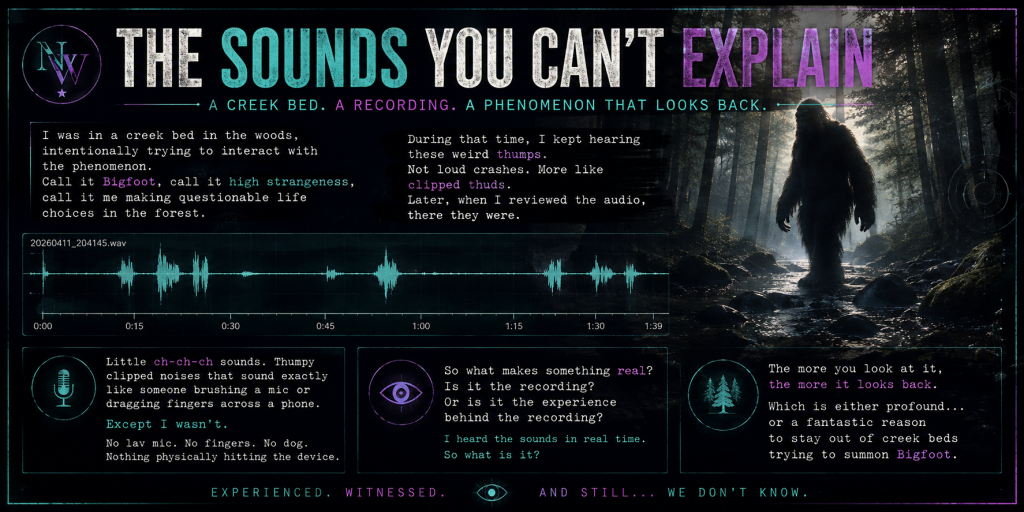
This audio clip in the above graphic has had me in an absolute mental chokehold ever since I recorded it.
It happened during an investigation at Leatherwood Lake near Eureka Springs, Arkansas. I was standing alone in a creek bed, intentionally trying to interact with the phenomenon. Call it Bigfoot. Call it high strangeness. Call it a questionable life decision involving a forest, a recorder, and an unhealthy amount of curiosity.
Whatever you call it, I was there with a purpose.
I wasn’t hiking. I wasn’t sightseeing. I wasn’t accidentally stumbling into an experience. I was actively attempting communication. At the time, I kept hearing these strange sounds.
Not loud crashes. Not branches breaking. Not the dramatic woodland noises people imagine when they think of a Bigfoot encounter.
These were smaller.
Short.
Clipped.
Almost mechanical.
Little thumps. Tiny ch-ch-ch sounds. The kind of noise that immediately makes you think something brushed the microphone or bumped the recording device. The sounds caught my attention in real time. I remember hearing them and looking around, trying to identify the source. Nothing stood out. No animal movement. No obvious environmental explanation. Just enough of a sound to make me notice it.
Later, when I reviewed the audio, there they were.
Exactly where I remembered hearing them.
The problem is that if I played this recording for a random person with no context, most people would probably hear what sounds like microphone interference or handling noise.
And honestly? That’s fair.
I understand why.
If someone handed me an audio file and said, “Listen to this strange noise,” I’d probably reach for the most ordinary explanation first, too.
That’s how investigation is supposed to work.
The challenge is that I was there.
I know what was happening when those sounds occurred.
There was no lavalier microphone rubbing against clothing. No fingers dragging across a phone screen. No dog bumping the device. No branch hitting the recorder. No obvious physical interaction with the equipment.
Yet the sounds were present both in the environment and on the recording. And this is where paranormal investigation starts getting messy. Because at some point, you run into experiences that refuse to fit neatly into the evidence model most people want.
We like the idea that evidence should be clean.
A photograph.
A video.
An audio clip.
A footprint.
Something tangible that can be placed on a table and examined independently of the witness.
But after years of investigating paranormal phenomena, UFO encounters, synchronicities, spirit communication reports, and high strangeness events, I’m not convinced the phenomenon operates that way.
In fact, the older I get, the more I find myself revisiting the work of Jacques Vallée and John Keel.
Both men spent decades studying cases that seemed to blur the boundaries between physical evidence, folklore, psychology, consciousness, and the paranormal. Neither of them believed the phenomenon was as simple as extraterrestrials landing in spaceships or undiscovered creatures hiding in the woods.
Instead, they described something far stranger. A phenomenon that interacts with observers. A phenomenon that adapts. A phenomenon that seems capable of presenting itself through symbols, experiences, synchronicities, and personal encounters.
Keel called its aspects the superspectrum.
Vallée described a control system.
Both frameworks suggest that whatever we’re dealing with may not simply exist as an object waiting to be discovered. It may exist as part of a relationship between observer and event. And that’s the part that has been rattling around in my head ever since reviewing this recording.
Maybe the real question isn’t whether the audio proves anything. Maybe the real question is why the experience happened the way it did.
Why did the sounds occur while I was attempting interaction?
Why did I hear them in real time? Why did they appear on the recording? And why do they occupy that frustrating middle ground between evidence and ambiguity?
The phenomenon seems remarkably good at living in that space. It gives you enough to make you pay attention. Enough to make you wonder. Enough to make you question your assumptions. But rarely enough to satisfy the courtroom part of your brain that wants certainty.
That’s what makes these experiences so difficult to communicate. Because maybe the recording isn’t the evidence. Maybe the experience itself is. Maybe the evidence is the interaction.
The moment. The context.
The relationship between witness and event. And if that’s true, then the phenomenon doesn’t simply exist somewhere out there waiting to be measured. It exists in the exchange.
The more you look at it, the more it looks back.
Which is either a profound insight into the nature of consciousness and paranormal experience…Or an excellent reason to stay out of creek beds trying to summon Bigfoot.
This experience is only one small piece of a much larger investigation. Over the coming months, I’ll be publishing additional articles exploring the Bigfoot phenomenon, high strangeness, Leatherwood Lake, CE5-style contact experiments, Jacques Vallée’s Control System hypothesis, John Keel’s superspectrum, and the strange ways these experiences seem to blur the line between paranormal investigation and personal transformation.
Because the deeper I dig into this subject, the less convinced I am that we’re dealing with isolated events. The patterns keep repeating. The questions keep getting stranger. And some of the most interesting evidence may not be what appears on a recording device, but what happens to the people who experience it.
Stay tuned. This rabbit hole goes much deeper.